
DPDPA Consent Management: What Organisations Need to Implement
Most organisations treat consent as a banner. DPDPA requires much more. Explore what to implement and how to operationalise consent compliance.

Most organisations today believe they’ve “handled consent.”
- They’ve added a cookie banner.
- Updated their privacy policy.
- Maybe even added a checkbox in their forms.
But under the Digital Personal Data Protection Act (DPDPA), 2023, consent is not a UI element.
It’s a core compliance requirement.
And most importantly, it’s something organisations must be able to demonstrate, not just display.
What DPDPA Actually Requires
DPDPA sets a clear expectation for how consent should be collected and managed.
Consent must be:
- Free - without coercion
- Specific - tied to a clear purpose
- Informed - users must understand what they’re agreeing to
- Unambiguous - no pre-checked boxes or assumptions
Beyond this, organisations must ensure:
✔ Consent is clearly communicated at the point of data collection
✔ It is linked to defined purposes
✔ It can be withdrawn as easily as it was given
✔ It is recorded and retrievable when required
This is where the gap between policy and implementation becomes visible.
What Most Organisations Get Wrong
In practice, consent is often treated as a one-time setup rather than an ongoing compliance process.
Some of the most common gaps include:
- Consent bundled into terms and conditions
- Lack of clarity on purpose-level consent
- No record of when or how consent was given
- No easy way for users to withdraw consent
- Consent not consistently applied across systems
These gaps make it difficult for organisations to prove compliance when required.
And under DPDPA, that proof matters.
What Organisations Should Implement
To align with DPDPA, consent needs to be structured and operationalised.
At a minimum, organisations should ensure:
- **Purpose-based consent collection
**Users should know exactly what they are consenting to. - **Clear and accessible choices
**No ambiguity or hidden consent. - **Consent recording with context
**Capture when, how, and for what purpose consent was given. - **Easy withdrawal mechanisms
**Users should be able to revoke consent without friction. - **Consistency across touchpoints
**Consent should be respected across all systems and interactions.
Consent, when implemented correctly, becomes a traceable and auditable process.
How to Operationalise Consent
This is where most organisations struggle.
Consent is not just collected, it needs to be managed across its lifecycle.
This includes:
- Capturing consent across forms, banners, and user journeys
- Storing consent with timestamps and purpose context
- Updating consent when users make changes
- Reflecting those changes across systems
- Retrieving consent records when required
Without structure, this quickly becomes difficult to manage — especially as systems grow.
How Neostra Helps
Neostra’s Consent Manager is designed to help organisations operationalise consent in line with DPDPA requirements. It enables teams to configure purpose-based consent experiences, capture and store consent records with context, and maintain audit-ready logs. By structuring how consent is collected, updated, and retrieved, it helps organisations ensure that consent is not just implemented, but also demonstrable.
Why Consent is the Foundation of DPDPA
Consent is not just one part of compliance. It is the starting point of everything that follows.
If consent is unclear or poorly managed:
- Data processing becomes questionable
- Privacy rights handling becomes inconsistent
- Compliance becomes difficult to prove
Strong consent practices create the foundation for trust, transparency, and accountability.
Putting Consent into Practice
Understanding consent requirements is one thing. Implementing them across systems and workflows is another.
Neostra’s DPDPA Readiness Program allows organisations to explore how consent can be structured and managed in practice along with other key compliance workflows.
It provides hands-on access to:
- Consent configuration and management
- Privacy rights workflows
- User-facing privacy interfaces
- Governance and readiness setup
This helps teams move from: Understanding consent to Implementing it effectively
Explore the DPDPA Readiness Program (Free Access)
Conclusion
Most organisations have taken the first step by acknowledging DPDPA.
The next step is building systems that support it and when it comes to DPDPA, that journey begins with getting consent right.
Start your DPDPA journey at No Cost - DPDPA Readiness Program
Keep reading.
All articles →
Implementing DPDPA Compliance: A Practical Checklist for Organisations
Learn how to implement DPDPA compliance with a practical checklist covering consent, privacy rights, data visibility, and governance.
How to Build a DPDPA-Compliant Intake Form: A Step-by-Step Guide
Discover how to create a DPDPA-compliant intake form with this step-by-step guide. Learn privacy form builder best practices, secure request verification, multilingual DSAR form setup, and how Neostra’s no-code intake form configuration simplifies privacy compliance in India.
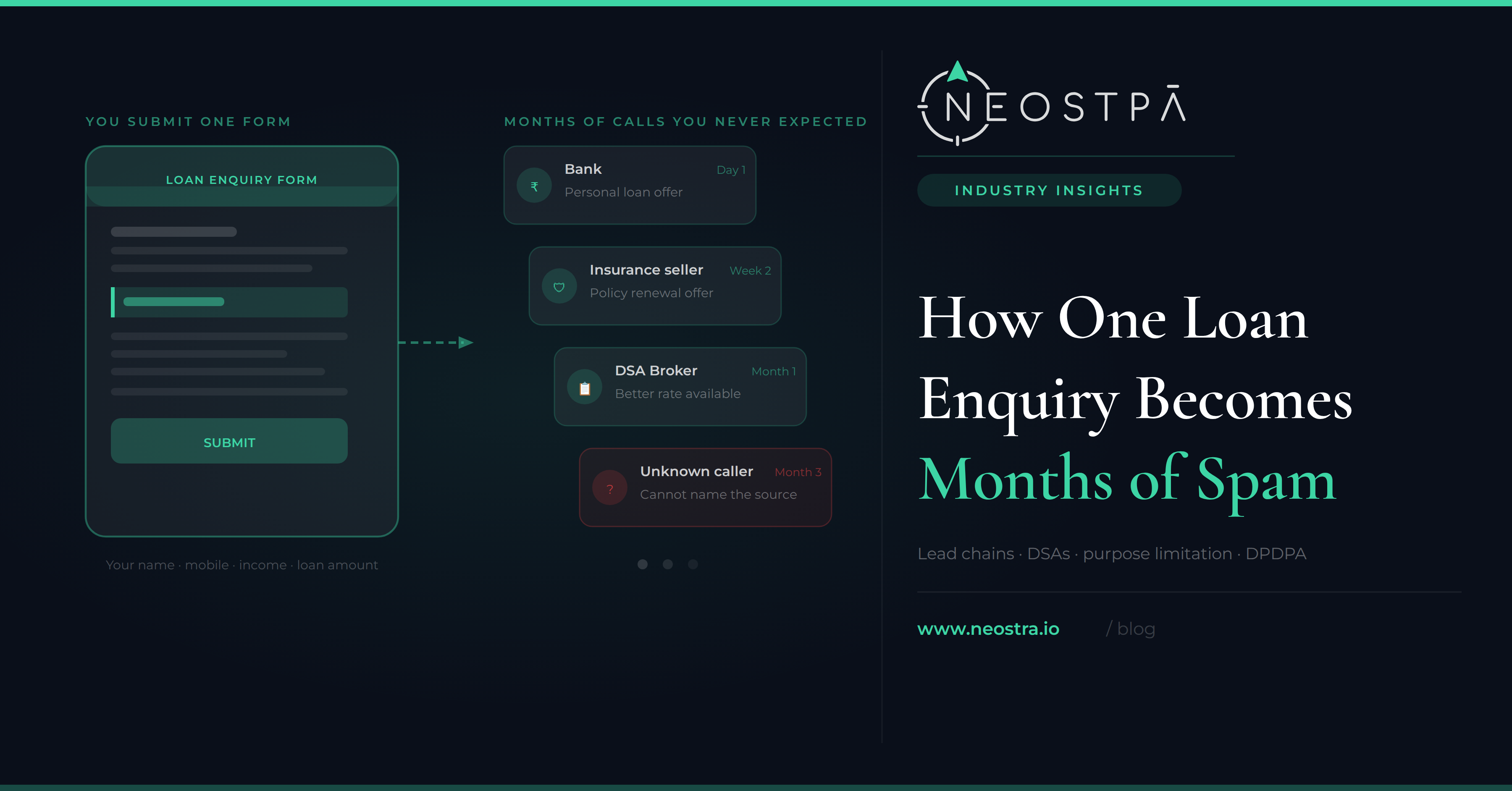
How One Loan Enquiry Becomes Months of Spam Calls
You filled out one loan form. Then the calls started from banks, brokers, insurance sellers, and people who can't tell you how they got your number. Here's what's actually happening, and what the law now requires companies to prove.
See what this looks like built.
A 30-minute walkthrough with a privacy specialist, on your use case.