
Implementing DPDPA Compliance: A Practical Checklist for Organisations
Learn how to implement DPDPA compliance with a practical checklist covering consent, privacy rights, data visibility, and governance.
Over the past year, organisations across India have become familiar with the Digital Personal Data Protection Act (DPDPA), 2023.
The focus is now shifting from awareness to a more practical question: How should organisations implement DPDPA in their day-to-day operations?
While many organisations have updated their policies, implementation requires something more fundamental like structured workflows, clear data visibility, and operational accountability.
DPDPA compliance is not achieved through documentation alone. It depends on how well organisations can translate requirements into systems and processes.
To help teams approach this systematically, here is a practical DPDPA compliance checklist.
DPDPA Compliance Checklist
Organisations preparing for DPDPA should ensure they can:
✔ Provide clear and accessible privacy notices
✔ Collect and manage purpose-based consent
✔ Enable individuals to exercise privacy rights
✔ Provide a central privacy interface
✔ Identify where personal data exists
✔ Maintain a structured data inventory
✔ Establish DPDP readiness and governance processes
Each of these plays a critical role in building operational compliance.
Starting DPDPA Implementation?
If you're evaluating how to implement these capabilities in your organisation, you can explore Neostra’s DPDPA Readiness Program.
It provides structured access to key privacy modules to help teams understand:
- How consent can be configured
- How privacy requests are managed
- How workflows are structured in practice
Explore our DPDPA Readiness Program (Free Access)**
**
1. Privacy Notices and Transparency
What organisations should implement
Organisations must clearly inform individuals about:
- What personal data is collected
- The purpose of processing
- How the data will be used
- The rights available to individuals
- Contact details for grievance redressal
Notices should be available at the point of data collection and remain easily accessible.
How organisations can operationalise this
- Maintain structured privacy notices across all data collection points
- Ensure consistency across websites, forms, and applications
- Maintain version history and updates
- Provide multilingual support where required
Neostra’s Policy Notices enables organisations to centrally manage and publish privacy notices while ensuring consistency across all user touchpoints. With version control and contextual delivery, teams can keep notices updated and accessible, supporting transparency requirements under DPDPA.
2. Consent Collection and Management
What organisations should implement
Organisations must collect clear, informed, and purpose-based consent before processing personal data.
Consent should be:
- Specific to purpose
- Clearly communicated
- Recorded with evidence
- Easily withdrawable
How organisations can operationalise this
- Implement purpose-based consent collection across digital touchpoints
- Record consent with timestamps and context
- Allow users to update or withdraw consent
- Ensure consent records are audit-ready
Neostra’s Consent Manager enables organisations to collect, manage, and track purpose-based consent across digital interfaces. By maintaining clear consent records and audit trails, it helps ensure that consent is properly captured, managed, and demonstrable for compliance.
3. Privacy Rights Handling
What organisations should implement
DPDPA enables individuals to:
- Access their personal data
- Correct inaccurate data
- Request deletion
- Withdraw consent
- Raise grievances
Organisations must provide a mechanism to receive and fulfil these requests.
How organisations can operationalise this
A structured workflow should include:
- Central intake mechanism
- Identity verification
- Internal routing
- Timeline tracking
- Complete audit trail
Without structure, requests often become manual and difficult to manage.
Neostra’s Privacy Rights Manager enables organisations to receive, manage, and fulfil privacy rights requests through structured workflows. With central intake, verification, and tracking, it helps ensure requests are handled consistently, within timelines, and with complete audit visibility.
4. Unified Privacy Interface
What organisations should implement
Organisations should provide a single interface where individuals can:
- Access privacy notices
- Manage consent and preferences
- Submit privacy rights requests
- Track updates and communication
How organisations can operationalise this
- Build a central privacy interface
- Integrate all privacy interactions in one place
- Ensure accessibility and ease of use
Neostra’s Privacy Center provides a unified interface where individuals can access notices, manage consent, and track requests in one place. This improves transparency for users while helping organisations manage privacy interactions more efficiently.
5. Data Discovery
What organisations should implement
Organisations must understand where personal data exists across systems.
How organisations can operationalise this
- Identify systems storing personal data
- Map data flows across tools
- Monitor how data moves across systems
Neostra’s Data Discovery helps organisations identify where personal data resides across systems and understand how it flows. This visibility is essential for managing data responsibly and supporting compliance obligations.
6. Data Inventory
What organisations should implement
Organisations should maintain a structured record of:
- Data types
- Processing purposes
- Storage locations
- Retention timelines
- Ownership
How organisations can operationalise this
- Maintain a central data inventory
- Keep records updated
- Align data with processing purposes
Neostra’s Data Inventory enables organisations to maintain structured records of data processing activities, including what data is collected, where it is stored, and how it is used. This forms the foundation for governance and compliance reporting.
7. DPDP Readiness and Governance
What organisations should implement
DPDPA compliance requires organisations to move beyond reactive processes and establish ongoing governance and readiness.
This includes:
- Assessing compliance gaps
- Evaluating risks in data processing
- Defining internal accountability
- Preparing for regulatory expectations
- Maintaining documentation and audit readiness
How organisations can operationalise this
- Conduct structured privacy assessments
- Identify gaps against DPDPA requirements
- Establish governance workflows
- Maintain compliance documentation
Neostra’s Governance help organisations evaluate their DPDPA readiness and establish structured compliance processes. By enabling assessments, tracking risks, and maintaining documentation, it supports continuous governance and audit preparedness.
Moving from Policies to Operational Compliance
Most organisations today understand privacy requirements.
The next phase is execution.
DPDPA implementation depends on how effectively organisations can build capabilities across:
- Transparency
- Consent
- User rights
- Data visibility
- Governance
When these elements work together, compliance becomes structured, auditable, and scalable.
Neostra - Built for DPDPA. Designed by Privacy Experts.
Neostra is designed specifically to support organisations navigating modern privacy regulations, including DPDPA.
It is built by professionals with deep experience in data privacy, compliance workflows, and enterprise systems, with a strong understanding of how privacy requirements translate into operational processes.
This ensures that the platform is not just aligned with regulatory expectations, but also with how organisations actually implement compliance in practice.
Putting DPDPA Implementation into Practice
Understanding requirements is one part of the journey. The next step is seeing how these workflows actually work in practice.
Neostra’s DPDPA Readiness Program gives organisations access to a structured environment where teams can explore:
- Privacy rights request workflows
- Consent and preference management
- Privacy Center and user interactions
- Data visibility and governance setup
This helps organisations move from understanding compliance to implementing it operationally
Explore our DPDPA Readiness Program to get Free Access and start preparing for DPDPA compliance.
Keep reading.
All articles →
DPDPA Consent Management: What Organisations Need to Implement
Most organisations treat consent as a banner. DPDPA requires much more. Explore what to implement and how to operationalise consent compliance.
How to Build a DPDPA-Compliant Intake Form: A Step-by-Step Guide
Discover how to create a DPDPA-compliant intake form with this step-by-step guide. Learn privacy form builder best practices, secure request verification, multilingual DSAR form setup, and how Neostra’s no-code intake form configuration simplifies privacy compliance in India.
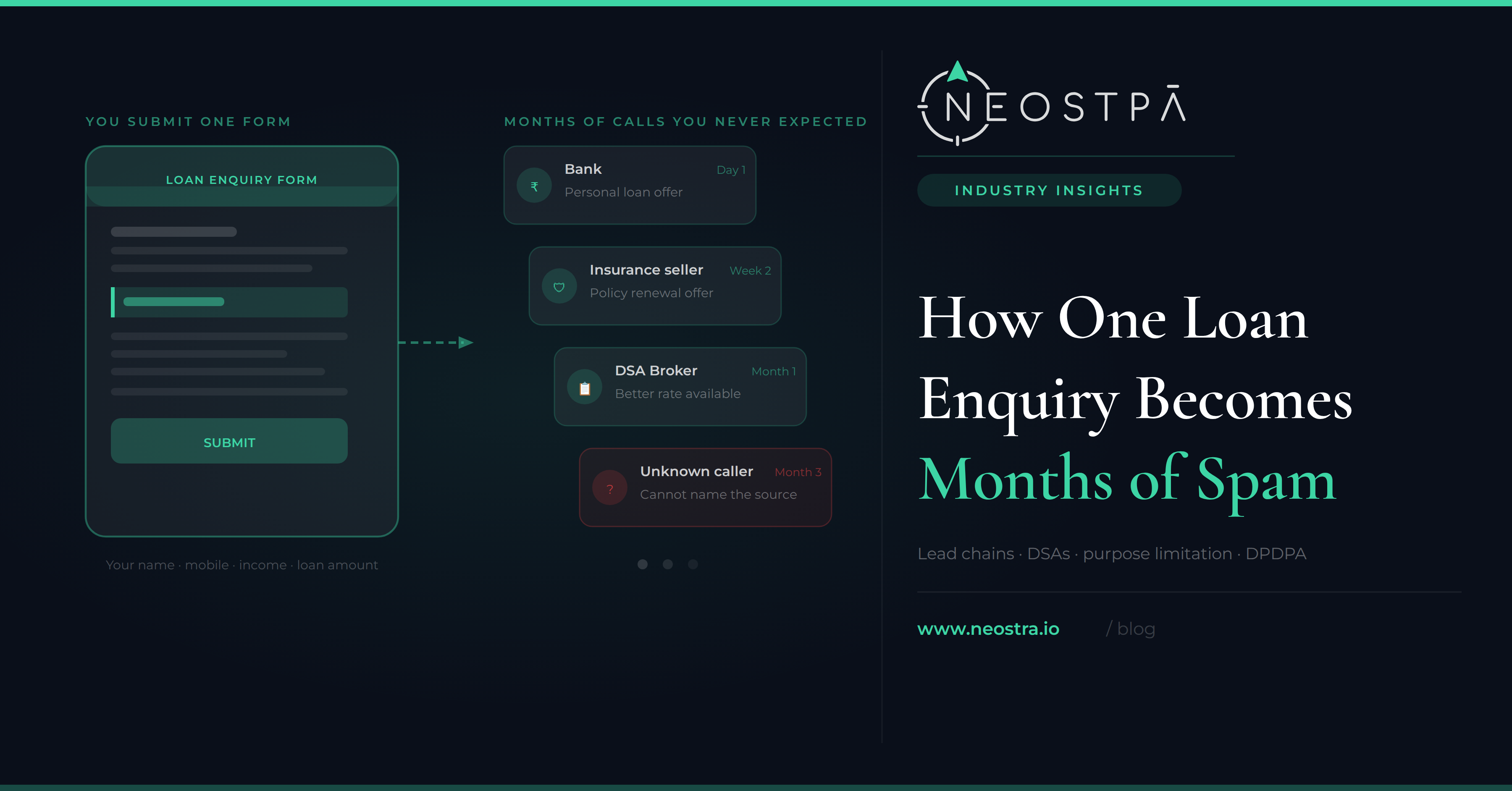
How One Loan Enquiry Becomes Months of Spam Calls
You filled out one loan form. Then the calls started from banks, brokers, insurance sellers, and people who can't tell you how they got your number. Here's what's actually happening, and what the law now requires companies to prove.
See what this looks like built.
A 30-minute walkthrough with a privacy specialist, on your use case.